lunes, 2 de febrero de 2015

LA CONQUISTA DEL ESPACIO

NASA Probe Snaps Amazing New Views of Dwarf Planet Ceres 

sábado, 31 de enero de 2015

ARTÍCULOS CIENTÍFICOS

What causes the aurora borealis or northern lights?

People at high northern latitudes sometimes experience an ethereal display of colored lights shimmering across the night sky – the aurora borealis or northern lights. What causes them?
Aurora just west of Saskatoon, by Colin Chatfield. He said, “We were just about to leave as the Aurora was just a dull band, then it came alive for about an hour or so. This was taken at 2:02am today [January 27, 2015] … It is not very visible, but I caught Comet Lovejoy at centre left of this photo.”
Those who live at or visit high latitudes might at times experience colored lights shimmering across the night sky. Some Inuit believed that the spirits of their ancestors could be seen dancing in the flickering aurora. In Norse mythology, the aurora was a fire bridge to the sky built by the gods. This ethereal display – the aurora borealis or aurora australis, the northern or southern lights – is beautiful. What causes these lights to appear?
Our sun is 93 million miles away. But its effects extend far beyond its visible surface. Great storms on the sun send gusts of charged solar particles hurtling across space. If Earth is in the path of the particle stream, our planet’s magnetic field and atmosphere react.
When the charged particles from the sun strike atoms and molecules in Earth’s atmosphere, theyexcite those atoms, causing them to light up.
What does it mean for an atom to be excited? Atoms consist of a central nucleus and a surrounding cloud of electrons encircling the nucleus in an orbit. When charged particles from the sun strike atoms in Earth’s atmosphere, electrons move to higher-energy orbits, further away from the nucleus. Then when an electron moves back to a lower-energy orbit, it releases a particle of light or photon.
What happens in an aurora is similar to what happens in the neon lights we see on many business signs. Electricity is used to excite the atoms in the neon gas within the glass tubes of a neon sign. That’s why these signs give off their brilliant colors. The aurora works on the same principle – but at a far more vast scale.
When charged particles from the sun strike air molecules in Earth's magnetic field, they cause those molecules' atoms to become excited. The molecules give off light as they calm down. Image Credit: NASA
The aurora often appears as curtains of lights, but they can also be arcs or spirals, often following lines of force in Earth’s magnetic field. Most are green in color but sometimes you’ll see a hint of pink, and strong displays might also have red, violet and white colors. The lights typically are seen in the far north – the nations bordering the Arctic Ocean – Canada and Alaska, Scandinavian countries, Iceland, Greenland and Russia. But strong displays of the lights can extend down into more southerly latitudes in the United States. And of course, the lights have a counterpart at Earth’s south polar regions.
The colors in the aurora were also a source of mystery throughout human history. But science says that different gases in Earth’s atmosphere give off different colors when they are excited. Oxygen gives off the green color of the aurora, for example. Nitrogen causes blue or red colors.
So today the mystery of the aurora is not so mysterious as it used to be. Yet people still travel thousands of miles to see the brilliant natural light shows in Earth’s atmosphere. And even though we know the scientific reason for the aurora, the dazzling natural light show can still fire our imaginations to visualize fire bridges, gods or dancing ghosts.
“This photo was captured a couple of hours ago in Nordreisa, Norway. I was dressed in my very best winter clothes and I can easily admit that I was freezing most of the time anyways, 22 below (-7.6 fahrenheit) kinda has that effect.” January, 2015. © 2015 Tor-Ivar Næss
Aurora in Vesterlålen, Norway, January 2015 by Stig Hansen
Mike Taylor in Maine caught this photo of last night's aurora.  More about Mike and this photo.
Mike Taylor in Maine caught this photo in September, 2014. More about Mike and this photo.
Photo © 2014 Tor-Ivar Næss
Photo credit: Hallvor Hobbyfotograf Lillebo
Aurora borealis over Norway’s Steinvikholmen Castle on April 3, 2014 by Hallvor Hobbyfotograf Lillebo.View larger. | Photo credit: Hallvor Hobbyfotograf Lillebo
Reisafjorden, Norway bathing in auroras on January 2, 2014.  Copyright 2014 Tor-Ivar Næss.
Reisafjorden, Norway bathing in auroras on January 2, 2014. When charged particles from the sun strike atoms in Earth’s atmosphere, they cause electrons in the atoms to move to a higher-energy state. When the electrons drop back to a lower energy state, they release a photon: light. This process creates the beautiful aurora, or northern lights. Image copyright 2014 Tor-Ivar Næss. Via WaitForIt on Facebook.
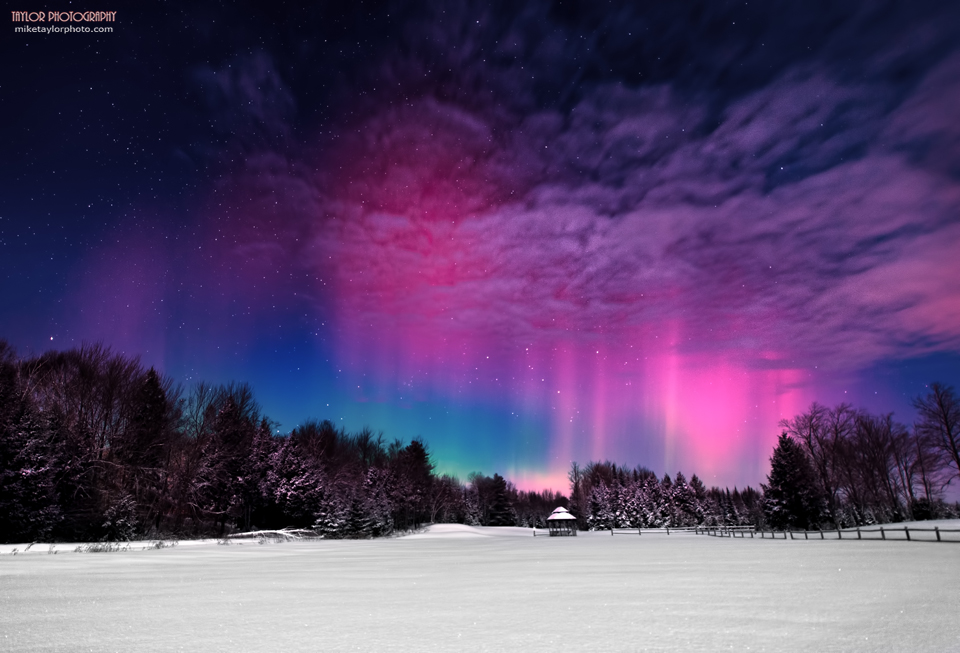
View larger. | Mike Taylor calls this photo Moonlight Aurora II.  He captured it on February 19, 2014.
View larger. | Mike Taylor calls this photo Moonlight Aurora II. He captured it on February 19, 2014. Visit Taylor Photography
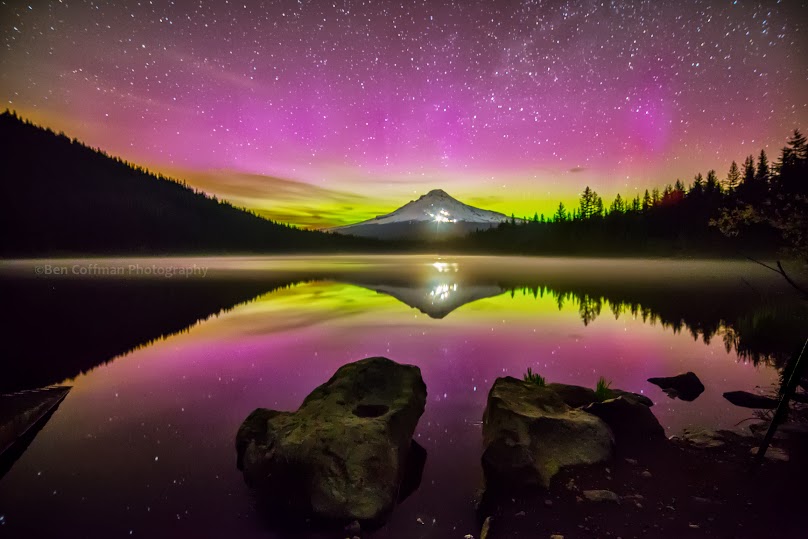
View larger. | Aurora over Mount Hood in Oregon as captured by Ben Coffman Photography during the night of May 31-June 1, 2013.
View larger. | Aurora over Mt. Hood in Oregon as captured by Ben Coffman Photography during the night of May 31-June 1, 2013. Visit Ben’s photography page on G+ or visit Ben on Facebook.
Aurora on January 1, 2014 by Geir-Inge Bushmann.  See more photos from Geir-Inge Bushmann
Aurora on January 1, 2014 by Geir-Inge Bushmann. The lights typically are seen in the far north – the nations bordering the Arctic Ocean – Canada and Alaska, Scandinavian countries, Iceland, Greenland and Russia. See more photos from Geir-Inge Bushmann
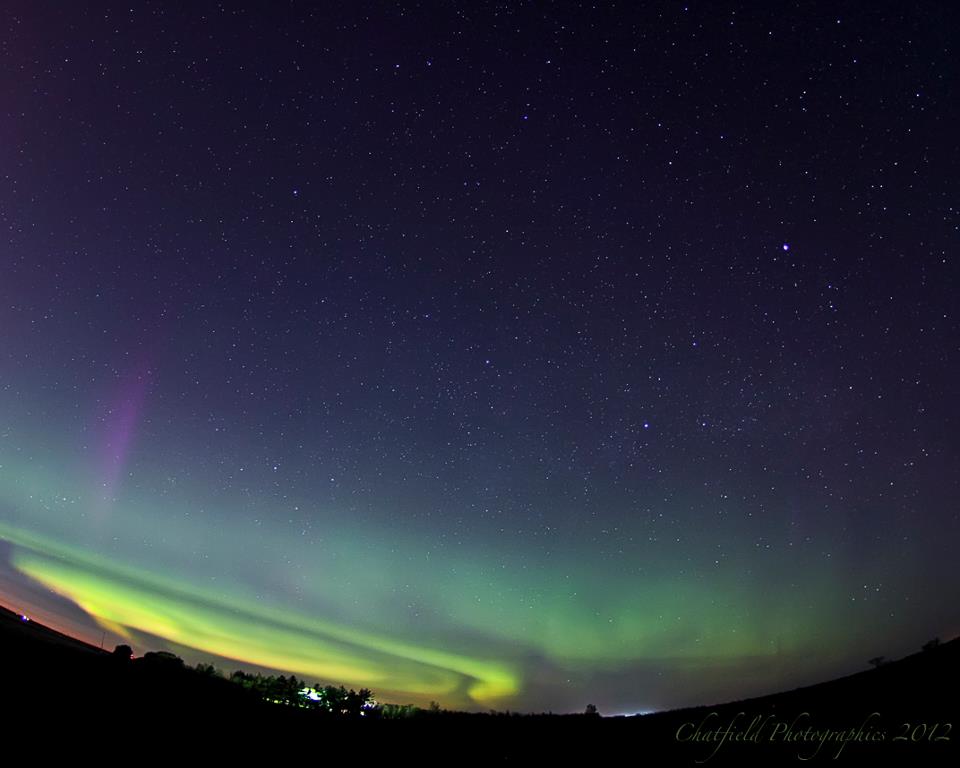
View larger. | Aurora seen by EarthSky Facebook friend Colin Chatfield in Saskatchewan, Canada on May 19, 2012.
View larger. | Spectacular aurora, or northern lights, seen by EarthSky Facebook friend Colin Chatfield in Saskatchewan, Canada on October 24, 2011.
Bottom line: When charged particles from the sun strike atoms in Earth’s atmosphere, they cause electrons in the atoms to move to a higher-energy state. When the electrons drop back to a lower energy state, they release a photon: light. This process creates the beautiful aurora, or northern lights.

domingo, 5 de octubre de 2014

ASTRONOMÍA

Artículo Científico

¿Qué son los Quasars? Esos objetos tan distantes y tan luminosos.

Fuente:  Tweeter  

Astronomers solve 20-year-old quasar mystery

This is an artist's concept of a quasar: a supermasive black hole at the center of a faraway galaxy.  Image via European Southern Observatory
New works suggests most observed quasar phenomena depend on two things: how efficiently a central black hole is being fed and the astronomer’s viewing orientation.This is an artist’s concept of a quasar: a supermasive black hole at the center of a faraway galaxy. Image via European Southern Observatory

Discovered in the early 1960s, quasars are highly luminous objects shining over vast intergalactic distances. Until the early 1980s, the nature of quasars was controversial, but now most astronomers agree a quasar is a supermassive black hole in the center of a distant massive galaxy. The black hole rapidly accretes (accumulates) matter toward its center to create a quasar’s powerful luminosity. Still, mysteries about quasars have remained, and now two scientists say they’ve solved a quasar mystery that astronomers have been puzzling over for 20 years. These scientists say that most observed quasar phenomena can be unified with two simple quantities: how efficiently the central black hole is being fed and the viewing orientation of the astronomer. The journal Nature published this work on September 11, 2014.

The study comes from the Carnegie Observatories‘ Hubble Fellow Yue Shen – who describes himself as a “quasarologist” – and Luis Ho of the Kavli Institute for Astronomy and Astrophysics (KIAA) at Peking University. They note that:Quasars are rapidly accreting supermassive black holes at the centers of massive galaxies. They display a broad range of properties across all wavelengths, reflecting the diversity in the physical conditions of the regions close to the central engine [black hole]. These properties, however, are not random, but form well-defined trends.

These “well-defined trends” are sometimes referred to as the “main sequence” of quasars. The trends were discovered more than 20 years ago, but the mystery since then has been: what causes these trends? That is the question answered by Shen and Ho.

To answer the question, they developed and conducted statistical tests on the largest and most-homogeneous sample to date of over 20,000 quasars from the Sloan Digital Sky Survey. In this way, they were able to demonstrate that one particular property – called the Eddington ratio – is the driving force behind the main sequence of quasars.The Eddington ratio describes the efficiency of matter fueling a quasar’s central black hole. That fueling process is essentially a competition between the gravitational force pulling matter inward and the luminosity driving radiation outward. This push and pull between gravity and luminosity has long been suspected to be the primary driver behind the so-called main sequence, and Shen and Ho say their work confirms this hypothesis.

They also found that the orientation of an astronomer’s line-of-sight when looking down into the black hole’s inner region plays a key role. In this inner region of the hole, fast-moving gas produces quasar spectra with broad emission lines. Knowing that the astronomer’s orientation with respect to the quasar is key to understanding quasar spectra will help astronomers improve their measurements of black hole masses for quasars, Shen and Ho say.

Shen said:Our findings have profound implications for quasar research. This simple unification scheme presents a pathway to better understand how supermassive black holes accrete matter and interplay with their environments.

Ho added:And better black hole mass measurements will benefit a variety of applications in understanding the cosmic growth of supermassive black holes and their place in galaxy formation.

Bottom line: The Carnegie Observatories’ Yue Shen and Luis Ho of the Kavli Institute for Astronomy and Astrophysics at Peking University conducted extensive statistical tests of over 20,000 quasars from the Sloan Digital Sky Survey. They now say most observed quasar phenomena depend on two simple quantities: how efficiently a central black hole is being fed and the astronomer’s viewing orientation.

domingo, 31 de agosto de 2014

LA PRINCESA DIANA --Reyna de Corazones--

Las teorías que rodean la trágica muerte de Diana

AUTOR: Mariana González Góngora @magogo88
                   Domingo 31 de agosto de 2014 a las 10:10


El accidente que sufrió la Princesa de Gales hace ya 17 años siempre ha estado rodeado de misterio. ¿Qué pudo haber estado detrás de este hecho? Aquí las teorías que intentan explicarlo.

  
El día de hoy se cumplen 17 años de que la "Princesa de la gente" muriera en un accidente de coche en París.


Desde que falleció Diana las diferentes teorías sobre su muerte no han parado y con el reciente aniversario, la nueva película, y el nacimiento de su nieto, este tema está presente otra vez alrededor del mundo. Es la historia que más ha generado teorías conspiratorias.


Lo que todo mundo sabe: La princesa de 36 años viajaba con su novio Dodi Al Fayed de 42 años en un Mercedes-Benz negro cuando se estrelló en la columna 13 del túnel del Pont del Alma en París, a las 12:23 a.m. el domingo 31 de agosto de 1997. Ella muere en el hospital tres horas y media más tarde -al parecer de un infarto-, y Dodi muere en el acto junto con el conductor del vehículo, Henri Paul. El único sobreviviente fue el guardaespaldas de Dodi, Trevor Rees-Jones.

  
Los culpables que se manejaron:
1. Los paparazzi: el accidente que los mató fue ocasionado porque el chofer estaba acelerando para evadir a los paparazzi. Como era de esperarse, la culpa cayó inmediatamente sobre ellos. Los críticos los llaman los acosadores y asesinos cobardes. Lo cierto es que llevaban parte de la responsabilidad por participar en una persecución a alta velocidad en condiciones muy peligrosas. Sin embargo, los resultados de la autopsia revelaron que Henri Paul, el conductor, tenía un nivel de alcohol en la sangre por lo menos tres veces por encima del límite legal. Al final de la investigación los paparazzi fueron exonerados en gran medida.


2. La familia real: Horas después del anuncio de su muerte, los rumores de un complot para asesinar a la princesa Diana habían comenzado. Los principales culpables: la familia real, asistida por el servicio de inteligencia británico. Al parecer porque Diana estaba a punto de avergonzar a la corona casándose con Dodi Al Fayed, un musulmán, que se convertiría en el padrastro de los príncipes Guillermo y Harry. La historia dice que la familia real no podría soportar el escándalo, por lo que se asume que la muerte de Diana fue ordenada por la familia real, específicamente por el Príncipe Felipe, Duque de Edimburgo.


3. Los enemigos de Mohammed Al Fayed: Estos al parecer buscaban matar a Dodi como venganza contra su padre. La muerte de Diana fue incidental, pero nunca se evidenció nada en contra de ellos. De haber sido así, seguramente Mohammed hubiera exigido una investigación y eventual sanción. Algunas de las teorías más populares comentan que Diana estaba embarazada de Dodi Al Fayed y que la pareja estaba a punto de comprometerse, incluso un joyero francés declaró que un día antes del accidente Dodi había comprado un anillo de compromiso.

  
4. Diana: Sin duda la teoría de conspiración más extraña es la afirmación de que la princesa Diana fingió su propia muerte. Con la ayuda de Dodi y la enorme riqueza de su familia, Diana planificaba cuidadosamente un "accidente" para que así la pareja pudiera escapar y llevar una vida alejada de los medios. Esto es prácticamente imposible ya que una persona que planea tener un accidente a 121 mph es casi improbable que sobreviva, por lo que también se piensa que entonces el coche no iba tan rápido como se dice. Apenas seis horas antes de morir, Diana le dijo a un reportero del Daily Mail que estaba a punto de retirarse completamente de la vida pública. Esto apuntaría a que los cuerpos enterrados en ambas tumbas en realidad pertenecen a otras personas.


5. MI6: Al parecer el servicio secreto británico veía en Diana como una amenaza para el trono, y por lo tanto, para la estabilidad del Estado. Además el MI6 es sospechoso de espionaje contra Diana durante años, y muchos creen que estaban detrás de la filtración de las grabaciones de llamadas telefónicas. El guardaespaldas, Trevor Rees-Jones, al parecer estaba en contacto con los miembros de los servicios secretos y sobrevivió al accidente como prueba de que éste estaba con la conspiración para sofocar la amenaza de Diana.


Los grandes misterios:
Fiat Uno Blanco: El análisis de los restos del Mercedes demostraron que había evidencias de un Fiat blanco, ya que había rastros de pintura en la carrocería del Mercedes. Según Mohammed Al Fayed, el vehículo fue utilizado por los "servicios de seguridad" para bloquear la carretera en frente del Mercedes, provocando que se estrellaran contra la pared del túnel. El vehículo blanco nunca fue encontrado. Esto no fue incluido en el estudio de la Operación Paget.

Imágenes del circuito cerrado: Se declaró en 2003 que las cámaras de video que captaban la ruta del Mercedes funcionaban, pero no hay registros de alguna de las cámaras durante esa noche. El periódico The Independent también declaró en 2006 que hay más de 14 cámaras de circuito cerrado de televisión en el paso subterráneo del Puente de l' Alma, pero ninguna registró imágenes de la colisión fatal.


Cinturones de seguridad: Diana y Dodi no llevaban puestos los cinturones de seguridad. Investigadores franceses declararon que todos los cinturones de seguridad operaban perfectamente en 1998. El análisis de los restos del coche en 2005 mostraron que los cinturones de seguridad se encontraban en buen estado, así es como se cree que el daño se produjo tras el accidente.


El conductor Henri Paul: El hecho de que haya muerto en el accidente hace pensar que él no estaba en la planeación del accidente. Pero de acuerdo con los que estudian el caso, Henri Paul, el conductor del Mercedes, fue contratado por el servicio de seguridad nacional. La prueba principal es que llevaba mucho dinero en efectivo en el momento del accidente.

  
Conclusión: Operación Paget
Lord Stevens, ex jefe de Scotland Yard, realizó una investigación de tres años para determinar si hubo una conspiración para asesinar a la mujer más famosa del mundo en 1997. El informe de casi 900 páginas compilado por alrededor de 14 detectives de Scotland Yard, con un costo de 3.7 millones de libras, fue publicado el 14 de diciembre de 2006. En tal documento se afirmaba que Henri Paul conducía al doble del límite de velocidad (60 mph) y que había consumido una cantidad muy considerable de alcohol antes de transportar a Diana y Dodi. Si el conductor hubiera sobrevivido, posiblemente hubiese sido enjuiciado por la manera en la conducía (velocidad y alcohol).


El encargado de la operación declaró: "Nuestra conclusión es que, con toda la evidencia disponible hasta el momento, no hubo conspiración para asesinar a ninguno de los ocupantes del vehículo. Fue un accidente trágico". La negligencia, la alta velocidad y la persecución ocasionaron una tragedia.

   
Expertos en toxicología dicen que el informe de la Operación Paget es un completo misterio. Algunas de las quejas es por la cuestión de que la sangre del conductor no era de él si no de alguien más. Además un bombero francés, Christophe Pelat, descubrió el cuerpo de un fotógrafo paparazzi llamado James Andanson (posible conductor del Fiat Uno) en un bosque con un tiro en la cabeza tres años después del accidente. El nombre del bombero y su testimonio -al igual que los de muchos otros- no aparece en ninguna parte del informe de la Operación Paget, en lo que fue considerado como el relato definitivo sobre la muerte de Diana.


Hoy día una vez más, 16 años después de su muerte, Scotland Yard se ve obligado a retomar el tema con un expediente nuevo ya que un soldado (no se conoce el nombre), dejó una carta en donde menciona que el SAS estaba detrás de la muerte de la princesa Diana. La ligereza de esta evidencia potencial es obvia, sin embargo la policía está obligada a darle seguimiento. Para muchos, se puede decir que este caso nunca se cerrará.